
Negro Canto
Art and Music Therapy as a Way of Confronting Racism
DOI:
https://doi.org/10.15845/voices.v25i3.4567Keywords:
music therapy, racism, feminism, decolonialityAbstract
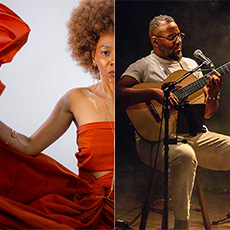
In this paper, we explore how art and music therapy serve as instruments of resistance and confrontation against racism, focusing on the experiences of Black women. As Black people, we observe the loneliness and challenges of being in predominantly white academic and professional spaces, where our skin color always arrives first. Based on these experiences, we analyze how art, performance, and music therapy can serve as strategies for resistance, affirmation, and emancipation of socially marginalized identities. The performance “Negro Canto,”inspired by Elza Soares, Conceição Evaristo, and Lélia Gonzalez, is presented as a political act that transforms individual pain into social denunciation, confronting violence and silencing. Thus, more than a denunciation, this article advocates for a decolonial and emancipatory music therapy that values the life experiences of marginalized populations, reinforcing the need for practices that use music to reconstruct narratives, strengthen identities, and promote social justice.
Editorial Comment
From the heart of their own experiences, Mirandah and Junio ask us about the responses we give to the presence of racism in the field of music therapy training and practice. Their experiences are those of alienation, injustice, and violence. But, in addition to helping us bring some uncomfortable issues to light, they remind us of the immense power of voice, shouting and singing, dance and music, when shared with others. Thank you!
Published
How to Cite
Issue
Section
License
Copyright (c) 2025 Líz Mirandah, Wagner Junio Ribeiro

This work is licensed under a Creative Commons Attribution 4.0 International License.
Articles published prior to 2019 are subject to the following license, see: https://voices.no/index.php/voices/copyright