
What are You All Going to Do to Keep Black Women in Art Therapy?
A Womanist Manifesto for Creative Arts Therapies Education
DOI:
https://doi.org/10.15845/voices.v21i1.3200Keywords:
Black women, arts therapies education, placemaking, Africana womanism, Cliff Joseph, critical pedagogyAbstract
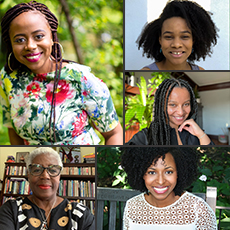
In this viewpoint, the authors describe their impressions of a 2018 conference and the significance of participating in a learning environment that centered on arts therapists of color. Collectively, two art therapy educators, a music therapy educator, one new professional art therapist, and one art therapy graduate student, question the maintenance of professional norms that have at times motivated BIPOC students and practitioners to leave the creative arts therapies in search of other professional places to thrive. The article concludes with a Womanist Manifesto for Arts Therapies Education.
References
American Music Therapy Association. (2017). AMTA member survey and workforce analysis: A descriptive statistical profile of the AMTA membership and the music therapy community. American Music Therapy Association, Inc.
Cohen, F. W. (1973, November 19). Correspondence 1973–74. [Letters from AATA to Lucille Venture]. http://www.arttherapy.org/aata-archives-historicfiguresfounders.html
Collins, P. H. (1998). Fighting words: Black women and the search for justice. University of Minnesota Press.
Crenshaw, K. (1989). Demarginalizing the intersection of race and sex: A Black feminist critique of antidiscrimination doctrine, feminist theory and antiracist politics. University of Chicago Legal Forum, 1989(8), https://chicagounbound.uchicago.edu/uclf/vol1989/iss1/8/.
Doby-Copeland, C. (2006). Things come to me: Reflections from an art therapist of color. Art Therapy: Journal of the American Art Therapy Association, 23(2), 81-85, https://doi.org/10.1080/07421656.2006.10129646.
Farris, P. (2006). Mentors of diversity: A tribute. Art Therapy: Journal of the American Art Therapy Association, 23(2), 86-88.
Floyd-Thomas, S. (2006). Deeper shades of womanism in religion and society. University Press.
Gipson, L. (2019). Envisioning Black women’s consciousness in art therapy. In S. Talwar (Ed.), Art therapy for social justice: Radical intersections (pp. 96-120). Routledge.
Grande, S. (2018). Refusing the university. In E. Tuck & K. W. Yang (Eds.), Toward what justice?: Describing diverse dreams of justice in education. Routledge.
Hiscox, A. R. (1997). Interview—Cliff Joseph: Art therapist, pioneer, artist. Art Therapy: Journal of the American Art Therapy Association, 14(4), 273-278, https://doi.org/10.1080/07421656.1987.10759297.
hooks, b. (1995). Art on my mind: Visual politics. The New Press.
Johnson, T., Deaver, S. P., & Doby-Copeland, C. (2021). Art therapy students of color: The experience of seven graduate students. Art Therapy: Journal of the American Art Therapy Association, 38(1), 50-56, http://doi.org/10.1080/07421656.2020.1862603.
Jones, L. (1965). The revolutionary theatre. Liberator, 5(5), 4-6.
Joseph, C. (1974). Art therapy and the third world: A panel discussion presented at the 5th Annual Convention of the American Art Therapy Association [Monograph].
Joseph, C. (1989). Art, politics, and the life force. Forward: Journal of Socialist Thought, 9(1).
Joseph, C. (2006). Creative alliance: The healing power of art therapy. Art Therapy: Journal of American Art Therapy, 23(1), 30-33.
Kahler II, E. P. (1997). The life of Richard M. Graham: President during a changing time. Journal of Music Therapy, 34(2), 106-118, https://doi.org/10.1093/jmt/34.2.106.
Kelley, R. D. G. (2008). Freedom dreams: The Black radical imagination. Beacon Press.
Kenny, C. (1989). The field of play: A guide for the theory and practice of music therapy. Ridgeview Publishing Co.
Nash, J. C. (2019). Black feminism reimagined: After intersectionality. Duke University Press.
Norris, M. (2020). A call for radical imagining: Exploring anti-Blackness in the music therapy profession. Voices: A World Forum for Music Therapy, 20(3), https://doi.org/10.15845/voices.v20i3.3167.
Ragland, Z., & Apprey, M. (1974). Community music therapy and adolescents. Journal of Music Therapy, 11(3), 147-155, https://doi.org/10.1093/jmt/11.3.147.
Talwar, S. (2019). Art therapy for social justice: Radical intersections. Routledge.
Published
How to Cite
Issue
Section
License
Copyright (c) 2021 Leah Ra'chel Gipson, Marisol Norris, Leah Amaral, Johanna Tesfaye, Anna Hiscox

This work is licensed under a Creative Commons Attribution 4.0 International License.
Articles published prior to 2019 are subject to the following license, see: https://voices.no/index.php/voices/copyright